What makes AEC different
Three properties of the domain shape everything about how AI should be applied here:
- Fragmented sources. The same fact — a fixture's mounting height, a room's occupancy — can live in the model, a drawing, and a schedule simultaneously, sometimes disagreeing.
- High-consequence determinations. A wrong "compliant" call on life safety, structural or mission-critical systems isn't a bad recommendation — it's a liability.
- An industry that already has rigor. QA/QC, submittals, RFIs, stamped drawings — AEC has decades of process discipline. AI that ignores that discipline gets ignored back.
Put together: this is a domain where an LLM's fluency is a liability if it's allowed to also be the authority.
The architecture this implies
The approach I use separates two concerns that generic AI products usually blur together:
- Investigation — retrieval, interpretation, evidence-gathering. This is where AI adds real value: reading unstructured drawings, reconciling formats, tracing a requirement through a large model faster than a person can.
- Determination — the actual compliant/non-compliant call. This stays deterministic: a fixed rule evaluated against assembled evidence, not a model's confidence score.
AI investigates. Governed logic decides.
That boundary is the whole architecture, and it's the difference between a tool an AEC firm can put in front of a stamped deliverable and one it can't.
Evidence over confidence
A determination that can't point to its source isn't useful to a reviewer who has to sign off on it. Every conclusion needs a traceable path back to the drawing, schedule row or model element that supports it — not a probability score. This is what makes a result auditable months later, when someone asks why a requirement was marked met.
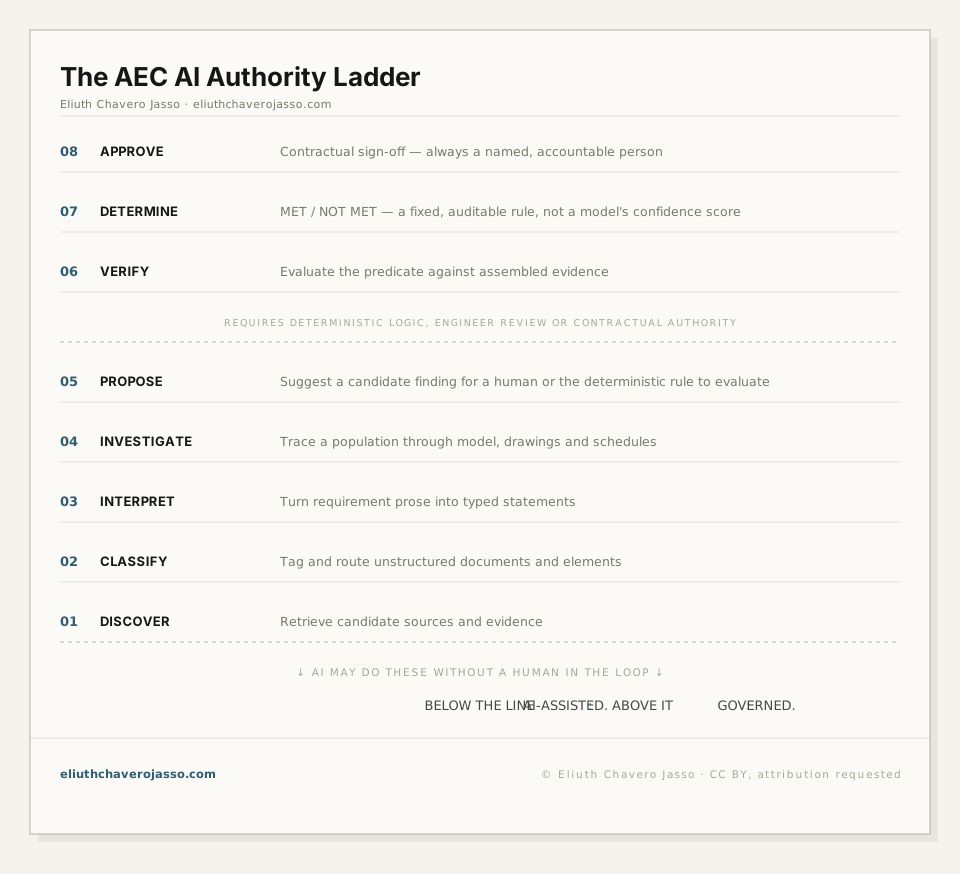
The AEC AI Authority Ladder
This is the investigation/determination boundary made concrete. Eight rungs, read bottom to top: discovery, classification, interpretation, investigation and proposal all sit below the governance boundary — AI may do these freely. Verification, determination and approval sit above it, and require deterministic logic, engineer review or contractual authority, never AI alone.
What this looks like built
The Engineering Intelligence Platform case study is this architecture applied to owner-requirements verification, shipped as a Revit add-in rather than a separate tool. The Evidence Graph and Verification Playground are smaller, synthetic demonstrations of the same investigate-then-verify shape.