Most AI roles split into two halves: research that never ships, and product that never touches the hard domain problem. Forward deployed work refuses that split.
What "forward deployed" actually means
A forward deployed engineer works from inside the customer's problem, not from a backlog someone else wrote. That means direct exposure to the domain's real constraints — the documents, the models, the people, the workflows that were already running before any software showed up — and technical ownership of everything downstream of that: architecture, implementation, validation, deployment.
It is not consulting. Consulting ends at a recommendation. Forward deployed engineering ends at a working system, in production, that the domain experts actually use.
Why this matters more for AI than for typical software
Generic software has a spec. Complex engineering domains — AEC, mission-critical infrastructure, regulated industries — mostly don't. The requirements exist as prose scattered across drawings, schedules and institutional memory. An AI system built without direct exposure to that mess tends to solve the wrong problem cleanly, which is worse than solving the right problem roughly.
Direct exposure changes what you build. It's the difference between "add a chatbot to the existing tracker" and recognizing that the tracker itself encodes the wrong unit of work.
How I work
The shape is consistent across projects, even when the domain isn't:
- Discovery. Understand the domain's real objects — requirements, obligations, evidence, the people who sign off — before writing a line of product code.
- Architecture. Decide, explicitly, what's deterministic and what's AI-assisted. This decision shapes everything downstream and is usually the highest-leverage call in the whole project.
- Implementation. Full-stack, because the constraint set spans desktop integration, backend, data and sometimes AI inference — splitting that across teams too early loses the domain context that made the architecture correct.
- Validation. Automated tests plus structured UAT against the actual domain experts, not a synthetic benchmark.
- Deployment. Into the tool the domain already uses. If it requires the user to change their workflow to adopt it, the deployment already failed.
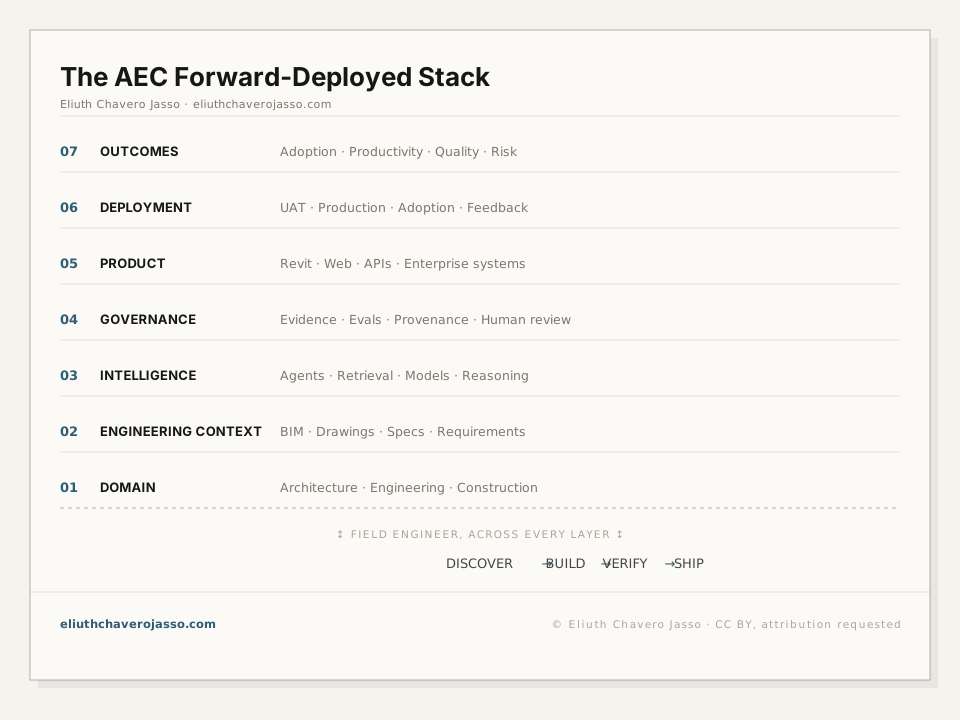
The AEC Forward-Deployed Stack
Seven layers, read bottom to top: domain knowledge grounds engineering context, which intelligence reasons over, which governance keeps accountable, which becomes a product, which gets deployed, which produces an outcome someone can measure. The field engineer's work — discover, build, verify, ship — cuts across every layer at once; it isn't a stage of its own.
A working example
The Engineering Intelligence Platform case study on this site is the clearest illustration: an AI investigation layer paired with deterministic, evidence-backed verification, built and shipped inside Revit rather than as a separate tool engineers would have to remember to open.
The failure mode this avoids
The common failure in applied AI is treating the model as the product. In high-consequence domains, the model is one component of a system whose actual job is producing a decision someone can be held accountable for. That system needs population definitions, evidence provenance, and a governance boundary that says explicitly where AI's authority ends. Forward deployed engineering is what it takes to get all of that right, because none of it is visible from outside the domain.