← Independent research

SEION Math Core

The claim is only as good as the check that would have caught it.

SEION Math Core is a research repository for typed finite-dimensional n-ary laws: associator and symmetry defects, structure-preserving projectors, finite cohomological checks. Every claim in it carries an explicit status. This page applies that same discipline to the repository's largest computed artifact — and the artifact does not survive it intact.

Scope

A deliberately conservative nucleus.

A numerical residual is an observation, not a proof. A theorem with hypotheses stays conditional. Continuous limits, physical interpretation and applications are separate tracks, not results carried over by association.

What it defines
  • Typed finite-dimensional n-ary laws as structural tensors with explicit input and output dimensions.
  • Ternary composition conventions kept apart: five-input, anchored binary, and operadic partial composition are separate objects with separate functions.
  • Structure-preserving projectors and the closure leakage they do or do not incur.
What it measures
  • Associator and symmetry defects for a declared law, at a declared arity.
  • Finite cohomological and operator checks, with the differential and degrees fixed in advance.
  • Run-level evidence: every figure and paper table points back to a run identifier and a final_metrics.json.
What it is not
  • Not a physical theory. Continuous limits and physical interpretation are separate open tracks, not results.
  • Not knowledge-graph embedding, language-model compression, BIM, cosmology or trading — those are declared non-goals for the core package.
  • Not a proof engine. A numerical residual is an observation; a theorem with hypotheses stays conditional.

Featured artifact · independently re-measured

A 248-dimensional structure-constant tensor, checked against what E8 requires.

E8_Exact_v18_2/f_E8.npy holds fabc for a candidate basis of a 248-dimensional Lie algebra: 15,252,992 float32 entries, 61 MB, 3,904,800 of them nonzero. The checks below were run here, in float64, against the file as stored.

Loading measured geometry…

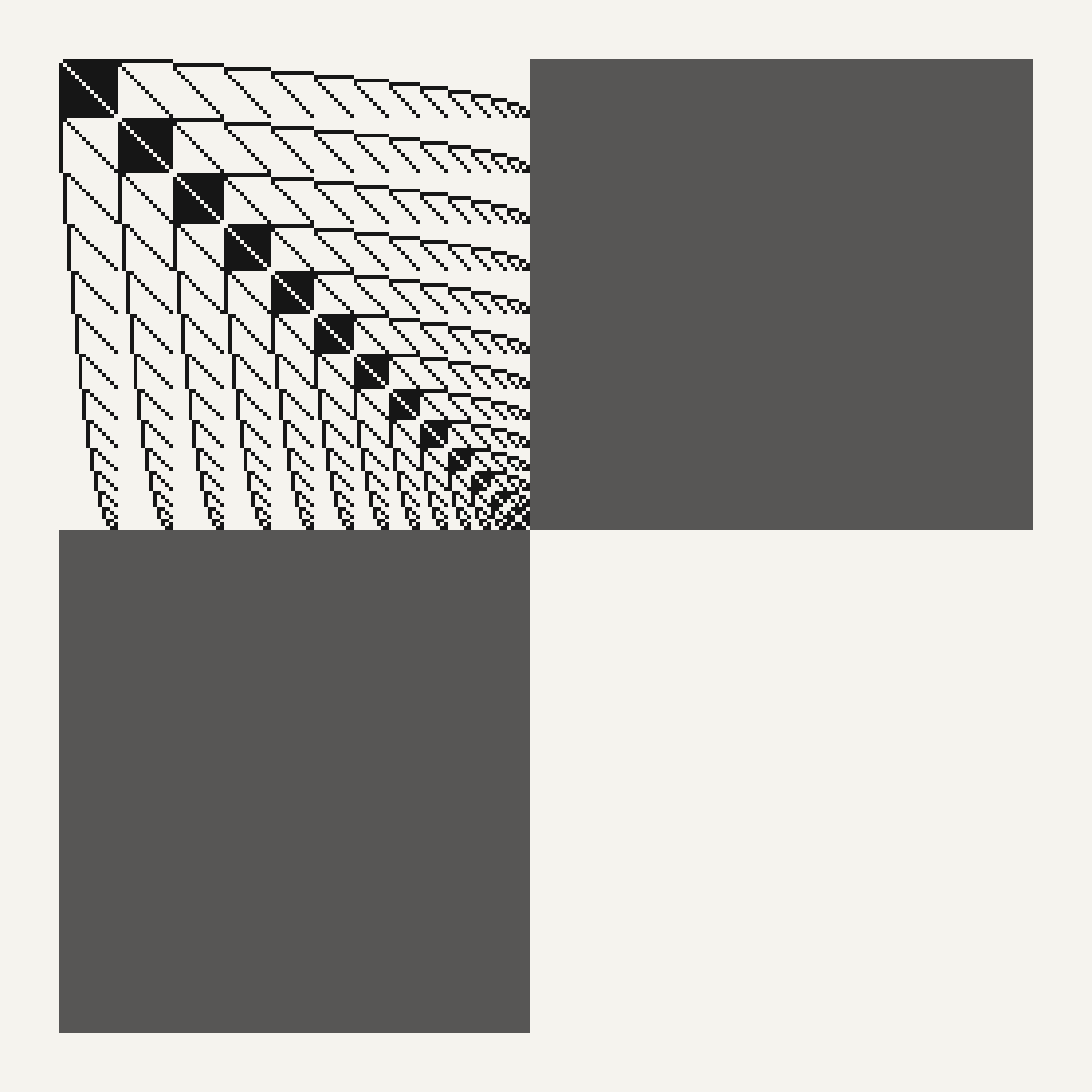
Drag to orbit; the cube stops turning on its own once you do. Every marker in k × k × k is one of the 3,360 nonzero entries, drawn four index units wide so that a sparse octant stays visible inside a 248-unit cube. The two mixed octants are aggregated 8³ per cell — they are 99.2% dense and flat to 3.4% across cells, so there is no finer structure to draw.

3,360 exact entries in k × k × k, plus the two dense mixed octants. 3 of 8 octants carry anything at all.

All eight octants of fabc
a × b × cEntriesNonzeroRole
k × k × k1,728,0003,360so(16) structure constants. Sparse, and exactly +2 or −2.
k × k × p1,843,200Empty.
k × p × k1,843,200Empty.
k × p × p1,966,0801,950,720The subalgebra acting on the spinor module.
p × k × k1,843,200Empty.
p × k × p1,966,0801,950,720The same action with the bracket arguments swapped.
p × p × k1,966,080[p, p] = k. The octant E8 needs, and the one that is empty.
p × p × p2,097,152Empty.

Every mixed pair couples with ‖f‖ = 1 to within 3.21e-8.p × k × p is the exact transpose of k × p × p in its first two indices, since f_ab^c = −f_ba^c. The renderer derives it rather than shipping it twice. Inside k × p × p the only vanishing component of [ea, eb] is the one along eb itself — 127 of 128 live, for every one of the 15,360 mixed pairs.

Killing form κab = tr(ada adb)

120 × -240 · 128 × 0. Rank 120 of 248.

Six properties E8 requires

4 hold2 do not

  1. Bracket antisymmetryholds

    f_ab^c + f_ba^c = 0

    exact zero

    The generator antisymmetrizes the tensor explicitly before saving, so this is a construction invariant rather than independent evidence.

  2. Jacobi identityholds

    f_ab^e f_ec^d + f_bc^e f_ea^d + f_ca^e f_eb^d = 0

    max residual 4.20e-08 over 61,011,968 residuals

    At the rounding floor for float32 storage, which carries about seven decimal digits. The bracket is a genuine Lie bracket.

  3. so(16) closureholds

    [k, k] stays inside the 120-dimensional block

    exact zero leakage

    The 120 block is so(16): its own Killing form is a multiple of the identity, and its structure constants take only the values 0, +2 and −2.

  4. 128 is an so(16) moduleholds

    [k, p] stays inside the 128-dimensional block

    exact zero leakage

    The induced representation also carries the right Dynkin index for the chiral spinor of so(16), which is what E8's grading requires.

  5. [p, p] bracket is non-trivialfails

    E8 requires [p, p] = k, so this block cannot vanish

    0 of 4,063,232 entries nonzero (identically zero)

    With this block empty the 128 is an abelian ideal and the algebra is the semidirect product so(16) ⋉ 128 — the İnönü–Wigner contraction of E8 along its symmetric-space grading, not E8.

  6. Killing form is non-degeneratefails

    rank tr(ad_a ad_b) = 248 for any real form of E8

    rank 120 of 248, with 128 zero eigenvalues

    The radical is exactly the block on which [p, p] vanishes. The rank of 248 reported by the generator comes from the Gram contraction f_acd f_bcd, which is positive semidefinite by construction and is not the Killing form.

Reading the result

It is a Lie algebra. It is not E8.

The Jacobi identity holds to 4.20e-08, which is the rounding floor of float32 storage, so the bracket is genuine. The 120-dimensional block is so(16) exactly. The 128-dimensional block is a real chiral spinor module over it, carrying the right Dynkin index. That is three quarters of E8's symmetric-space grading, built correctly.

What is missing is the fourth part. E8 decomposes as so(16) ⊕ 128 with [p, p] = k — the spinors have to bracket back into the subalgebra. In this file that block is identically zero across all 4,063,232 entries. An algebra with that shape is so(16) ⋉ 128, the İnönü–Wigner contraction of E8 along the same grading: the right dimensions, the right subalgebra, the right module, and an abelian ideal where the hard part of E8 should be. Its Killing form is degenerate on exactly those 128 directions, which is what the rank of 120 records.

Why the generator's own gates passed it

  • The Killing check is not the Killing form. The generator computes κAB = ΣCD fACD fBCD, the Gram matrix of the adjoint slices. That is positive semidefinite by construction and full rank whenever the slices are independent, so it reports 248 and cannot detect a degenerate bracket. The Killing form needs the transposed contraction facd fbdc, which gives 120.
  • Jacobi passes more easily, not less. Every triple with two or more spinor generators collapses the moment [p, p] = 0. Zeroing the block removes constraints from the identity rather than adding them.
  • Antisymmetry is enforced, then measured. The tensor is explicitly antisymmetrized immediately before it is saved, so the reported ratio of 0 is a property of the last line of the script, not of the algebra.
  • Nothing tested the block that mattered. The ansatz search selected a configuration whose [p, p] contribution is exactly zero, and no gate asked whether that block was non-vanishing.

What this does not mean

It does not invalidate the construction underneath. The Clifford algebra, the chirality split, the real-structure solve and the so(16) Gram inversion all produce exactly what they claim to. The failure is isolated and it is nameable: one bilinear map, from the spinor module back into the subalgebra, is missing. That is a fixable defect with a known target, which is a far more useful result than a green check would have been.

Source seion-math-core/E8_Exact_v18_2/f_E8.npy · sha256 6e7c211962707246… · re-measured by tools/generate_e8_tensor.py. The source's own summary recordsis_e8_like: true; that field and the measurements above disagree, and the disagreement is the finding.

Epistemic ledger

Statuses are load-bearing, including the bad ones.

A registry that only keeps what worked is a marketing document. These are claims as the repository files them, in the vocabulary it uses. Three of them are refuted and stay on the books.

Proved Unconditional within the stated finite-dimensional setting.Proved under assumptions Conditional. The hypotheses are listed with the claim.Numerically verified Checked to floating-point tolerance on declared examples.Empirical Measured on a declared sample. No general claim.Open Stated precisely enough to be attacked, and not yet resolved.Superseded Replaced by a later, better-specified question.Refuted The registry keeps it. That is the point of the registry.
  • Standard left-action curvature expansionProved

    For any bilinear product, [L_x, L_y] − L_[x,y] applied to z equals A(y, x, z) − A(x, y, z), with [x, y] = x∘y − y∘x.

    Holds only under Finite-dimensional bilinear product, stated commutator convention.

    THM_STANDARD_CURVATURE_ASSOCIATOR_DIFFERENCE_V1
  • Commuting finite operator descends to cohomologyProved under assumptions

    An operator commuting with the differential preserves cycles and boundaries, so it induces a map on the quotient.

    Holds only under d² = 0, same-degree linear operator, exact commutation.

    THM_COHOMOLOGY_DESCENT_FINITE_V1
  • Known block subspace closureNumerically verified

    For the declared block-supported example the coordinate projector has zero closure leakage up to floating-point evaluation.

    Holds only under One declared example, finite samples, float64.

    NUM_KNOWN_INVARIANT_CLOSURE_V1
  • Empirical closure-minimizing recoveryEmpirical

    A small stochastic Stiefel search can reduce sampled closure leakage on some declared examples. No general recovery or superiority claim is made.

    Holds only under Fixed seed, sample distribution, optimizer step count.

    EMP_PROJECTOR_RECOVERY_V1
  • Regime-limited advantage over truncation thresholdsEmpirical

    At m = 8 measured first order does not separate from static or adaptive threshold; at m = 10 it has lower mean normalized terminal error. Threshold stays much cheaper, so no Pareto dominance is established.

    Holds only under 35 seeds, heterogeneous D = 16 chains, equal terminal rank, exact terminal objective.

    EMP_ATN_FO_THRESHOLD_REGIME_SPLIT_V1
  • Uniform continuum limit for kernel-integrated lawsOpen

    A sequence of finite laws may converge in a specified topology under uniform estimates. This repository does not prove a general theorem.

    Holds only under Resolution sequence, topology, uniform bounds, compactness argument — none yet fixed.

    CONJ_CONTINUUM_LIMIT_V1
  • Downstream-aware allocation versus standard truncation thresholdsSuperseded

    This missing-baseline question was resolved by a later pre-declared gate and its fixed-size precision extension.

    Holds only under Required matched rank, memory, evaluation and wall-clock budgets.

    OPEN_ATN_THRESHOLD_COMPETITOR_V1
  • Continuity of spectral snapping without a gapRefuted

    Threshold snapping is not continuous when eigenvalues may cross the threshold.

    Holds only under No uniform spectral gap assumed.

    REFUTED_SNAPPING_NO_GAP_V1
  • General equal-rank superiority of pathwise allocationRefuted

    The pre-registered hypothesis that pathwise allocation lowers true root error against uniform, singular-energy and local-error-greedy allocation at equal rank is contradicted by the registered campaign.

    Holds only under Level 1 pre-registration, two declared topologies, ten seeds, equal rank budgets.

    REFUTED_ATN_PATHWISE_GENERAL_SUPERIORITY_V1
  • Certificate deltas as action-ranking surrogatesRefuted

    Across the 15 executed states, none of the scalar, restricted or Gram-aware certificate deltas selected the true best action. Tighter certification did not improve action ranking.

    Holds only under m = 8, 56 candidate bundles per state, three states per seed, five seeds.

    REFUTED_ATN_CERTIFICATE_ACTION_RANKING_M36_V1

Tracks

Four workstreams, each fail-closed.

Every track's build command exits non-zero while a publication gate is unresolved. Finishing the computation is not the same as clearing the gate, and the exit code says so.

v2

Foundations v2

Structure-preserving reduction, isolated from the legacy 0.1 release.

Fail-closed. The draft is explicitly not submission-ready: its exact-reduction and spectral results are not claimed as novel, and the audit records the remaining novelty and author-metadata blockers.

v3

Tree constants v3

Finite typed multilinear composition trees, nothing else.

A 15-stage workflow that rebuilds both papers, renders every page and audits all evidence. It exits non-zero while any publication gate is unresolved — completing the technical work is not the same as clearing the gate.

v4

Canonical repository v4

Governance, memory, evidence graph, packaging and release.

The campaign preserves incomplete runs rather than discarding them, separates mathematical claims from software evidence, and emits the exact unresolved blockers instead of a pass.

v5

Projected graphs v5

Exact projected-root sharpness for declared law classes.

Two theorems proved under assumptions, both carrying NOVELTY_NOT_ESTABLISHED and PENDING_HUMAN_REVIEW. The adjacent repeated-law question is filed as open with a precise boundary rather than left vague.

Research · structural views

Structure, claim status and reproducibility stay together.

These studies separate the mathematical object, its interpretation and the evidence supporting a claim.

R1
Structural projectionRelations before interpretation
R2
Claim statusDefinition · proof · numerical check
R3
Reproducible artifactInputs move through explicit stages